Why the cloud changed
The cloud didn’t become a problem overnight. It changed because the incentives changed.
Understanding that shift matters — because many organisations are still making decisions based on what the cloud used to be, not what it has become.
 `
`
Phase one: access and acceleration
In its early years, the cloud solved real problems.
It lowered the barrier to entry, removed capital risk, and let small teams build systems that previously required large budgets and specialist infrastructure.
- Infrastructure was easy to provision
- Costs were transparent enough to estimate
- Most services were interchangeable with self-hosted equivalents
For startups and fast-moving teams, this was transformative.
Phase two: platforms, not infrastructure
Over time, cloud providers stopped selling infrastructure and started selling platforms.
Databases, queues, analytics, identity, monitoring — all became managed services with proprietary APIs, behaviours, and pricing models.
These services were convenient. They were also non-portable.
- Architectures became tightly coupled to vendor features
- Exit paths became unclear or impractical
- Costs shifted from predictable to variable
At this point, leaving the cloud stopped being a technical question and became a business risk.
Phase three: optimisation for retention
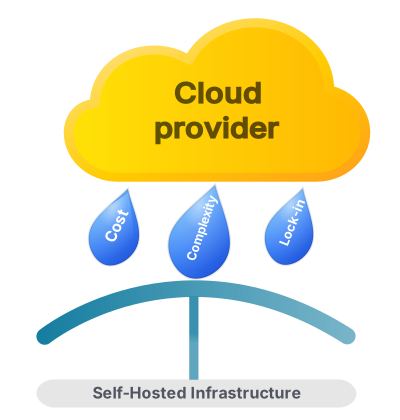
Today’s cloud is optimised for one thing: keeping you inside.
This isn’t about bad intentions. It’s about incentives.
Public cloud providers are large, regulated, profit-driven organisations. Their success depends on:
- Long-term customer dependency
- Rising per-customer spend
- Architectural lock-in
In that environment, easy exits are not a priority.
Lock-in isn’t a failure of design — it’s the design.
The regulatory shift
The assumption that cloud infrastructure is “someone else’s responsibility” is no longer holding.
In the UK, regulators are moving toward greater scrutiny of cloud services — including Ofcom’s expanding powers to inspect and assess cloud-hosted data and services.
This reflects a wider change:
- Cloud platforms are now critical infrastructure
- Data location and access matter
- Organisations remain accountable, even when infrastructure is outsourced
When regulators ask where your data lives and who can access it, “it’s in the cloud” is no longer a sufficient answer.
Why self-hosting is being reconsidered
The return to self-hosted infrastructure isn’t about nostalgia or ideology.
It’s about control.
Modern self-hosting — done properly — offers:
- Predictable, defensible costs
- Clear operational responsibility
- Full visibility into system behaviour
- Data that stays where you expect it to be
- An exit path that actually exists
Most importantly, it restores choice.
This isn’t about rejecting the cloud
RefugeX isn’t anti-cloud.
We’re anti-dependency without consent.
The cloud still has a place — for experimentation, burst capacity, and specific workloads. But it should be a tool, not a trap.
Infrastructure decisions should be reversible. Roadmaps should belong to organisations, not vendors.
Where RefugeX fits
RefugeX exists for organisations that have outgrown the assumptions of the modern cloud.
We help you step back from dependency, regain clarity, and move toward infrastructure you own — without disruption or panic.
Not because the cloud is evil. But because ownership still matters.
Want to understand your options?
If you’re questioning your current cloud position, a conversation can bring clarity — without pressure or commitment.
Start a conversation